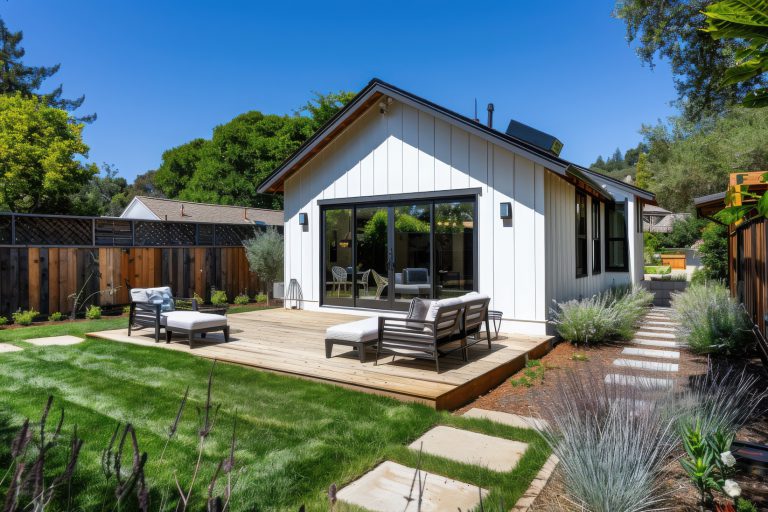
Thinking about adding a granny flat to your Gold Coast property? You are not alone. Since the Queensland Government removed occupancy restrictions in September 2022, secondary dwellings have become one of the most popular residential projects on the Gold Coast. Whether you want to house an ageing parent, create a teenage retreat, earn rental income, or simply add value to your property, a well-designed granny flat can achieve all of these — but only if you get the design and approvals right from the start.
As a dual-licensed builder and building designer, I have seen plenty of granny flat projects go sideways because the owner started building before understanding what the Gold Coast City Plan actually requires. This guide covers the design rules, approval process, and practical considerations you need to know before committing to a secondary dwelling project.
Under the Gold Coast City Plan, a granny flat is officially called a secondary dwelling. It is a self-contained living space built on the same lot as your existing house. It must be smaller than and subordinate to the primary dwelling — meaning it cannot be the dominant building on your property.
A secondary dwelling can be attached to your house, built underneath a raised home, or completely detached as a standalone building. It must include its own kitchen, bathroom, and living area to qualify as self-contained.
The standard maximum for a secondary dwelling on the Gold Coast is 80 square metres of gross floor area. Council may approve up to 120 square metres with proper justification, but exceeding 80 square metres triggers infrastructure charges — approximately $24,000 in sewered areas and $17,000 in non-sewered areas as of July 2025.
At 80 square metres, you can fit a comfortable one-bedroom layout with open-plan living, a bathroom, and a small laundry — or a compact two-bedroom layout where the living spaces feel apartment-scale. Storage is a real design challenge at this size, so built-in robes and clever joinery are essential.
At 120 square metres, a two-bedroom granny flat feels like a small home — full living and dining area, a proper laundry, and enough space for a covered outdoor area, which is almost a necessity on the Gold Coast where outdoor living is year-round.
Council will not allow a secondary dwelling to have more than two bedrooms. This is a strict rule regardless of the overall floor area. So the design challenge becomes making the most of your available space within these constraints — something a building designer can help you optimise.
| Size Tier | Floor Area | Bedrooms | Typical Layout | Infrastructure Charges | Approx Build Cost |
|---|---|---|---|---|---|
| Compact | 40-60 sqm | 1 | Open-plan living/kitchen, 1 bed, 1 bath, European laundry | Nil (under 80 sqm) | $150,000 – $180,000 |
| Standard | 60-80 sqm | 1-2 | Kitchen, living/dining, 1-2 bed, 1 bath, small laundry | Nil (at or under 80 sqm) | $180,000 – $220,000 |
| Large | 80-120 sqm | 2 | Full kitchen, living/dining, 2 bed, 1 bath, laundry, covered outdoor area | ~$17,000 – $24,000 | $220,000 – $250,000+ |
Build costs are indicative for the Gold Coast region as of 2025-2026 and vary based on site conditions, finishes, and builder selection. Infrastructure charges apply to dwellings exceeding 80 sqm GFA.
Most Gold Coast granny flat projects land in the $150,000 to $250,000 range for construction, depending on size, site conditions, and the level of finish. A basic one-bedroom build on a flat site with standard finishes sits at the lower end. A fully finished two-bedroom dwelling with quality fixtures and a covered outdoor area pushes toward the upper end.
On top of construction, budget for design fees, approval fees, and infrastructure charges if you exceed 80 square metres. Getting accurate design documentation before you seek builder quotes is the most reliable way to control costs, because builders price uncertainty into their margins.
Several design requirements regularly surprise people who start planning a granny flat without professional advice:
Matching materials and colours. Council prefers the secondary dwelling to match the primary house in materials and colour scheme. If the designs differ substantially, only one dwelling should be visible from the street. This is negotiable in many cases, but it needs to be addressed in your design documentation.
Shared driveway access. Council is increasingly strict about secondary dwellings sharing the same driveway as the primary house. Getting approval for a separate driveway is unlikely. Your design needs to account for vehicle access, turning, and an additional parking space without creating a second entry point.
The 10-metre proximity rule. Generally, the secondary dwelling must be within 10 metres of the main house, though larger or rural lots may have more flexibility.
Energy efficiency compliance. Your granny flat must meet the current National Construction Code energy efficiency requirements, including the 7-star NatHERS rating that came into effect under NCC 2022. For a small building, getting the orientation, glazing, and insulation right is critical — and it all starts at the design stage.
Every secondary dwelling on the Gold Coast requires building approval, obtained through a licensed building certifier. In many cases, you will also need development approval from Council first, particularly if your property is affected by overlays such as flooding, bushfire, or heritage. Understanding the difference between development approval and building approval early in your project helps you plan a realistic timeline and budget.
If your design meets all the requirements of the City Plan secondary dwelling code and your lot has no applicable overlays, your granny flat may qualify as accepted development — meaning you can proceed directly to building approval without a full Development Application. This saves time and money.
However, most properties have at least one overlay or site constraint that requires council assessment. A building designer who understands the council approval process can determine your approval pathway early and avoid costly surprises.
A granny flat is a small building, but it requires the same level of design documentation as a full house — structural details, site plans, floor plans, elevations, energy ratings, and specifications. Cutting corners on these documents leads to builder price uncertainty, construction delays, and compliance issues.
At Design Science, we approach every secondary dwelling project with the same rigour as a custom home design. Because we hold both a builder’s licence and a building designer’s licence, we design granny flats that are not just compliant and attractive — they are buildable and cost-effective. We understand how builders price from drawings, and we produce construction-ready documentation that eliminates guesswork from the quoting process.
The design fee for a secondary dwelling is modest compared to the construction cost, and it is the single most effective way to keep your project on budget and on track.
Beyond the regulatory requirements, there are practical design decisions that significantly affect how well your granny flat performs:
Orientation and cross-ventilation. The Gold Coast climate (NCC Climate Zone 2) rewards designs that capture prevailing breezes and minimise western sun exposure. The dominant summer breezes come from the north-east and south-east, so positioning living areas and operable windows to catch these breezes makes a measurable difference to comfort. Western sun is the biggest enemy of a small building — even one unshaded west-facing window can overheat a compact granny flat in summer. Where western glazing is unavoidable, external shading like adjustable louvres or deep eaves is far more effective than curtains. A well-oriented granny flat can reduce or eliminate the need for air conditioning. Our sustainable design approach ensures your secondary dwelling works with the local climate rather than against it.
Privacy for both dwellings. Thoughtful window placement, screening, and landscaping buffers can give both the main house and the granny flat a genuine sense of separation, even on a compact lot.
Accessibility. If the granny flat is for an older family member — or if you want to future-proof it — consider wider doorways (minimum 870mm clear opening), a step-free entry, and a hobless shower. These features cost very little to include at design stage but are expensive to retrofit later.
Services and infrastructure. Your granny flat connects to the same water, sewer, and electricity as the main house. The design must account for service runs, drainage falls, and connection points — all of which affect where you can practically locate the building on your site.
If you are considering a tiny home on a trailer or a transportable building as your secondary dwelling, be aware that these still require building approval if used for permanent living. The same design rules and size limits apply. A tiny home that does not meet the secondary dwelling code cannot legally be used as a permanent residence on the Gold Coast, regardless of how it is marketed.
Yes. Since Queensland removed the family-member-only restriction in September 2022, you can rent your secondary dwelling to anyone on the private rental market. Short-term letting (such as Airbnb) may be subject to additional planning requirements depending on your zone, so check with Council before listing.
Not always. If your property has no overlays and your design meets all criteria in the secondary dwelling code, it may qualify as accepted development — skipping the DA entirely. Most properties do have at least one overlay, though, so a DA is more common than people expect. A building designer can confirm the pathway before you spend money on full documentation.
It is possible, but the flood overlay adds complexity. Council will require minimum floor levels, no increased flood risk to neighbours, and safe evacuation access. In high-risk flood zones, approval may be impractical. A site-specific assessment is essential before committing.
If your project qualifies as accepted development (no DA required), you can have building approval within a few weeks once your documentation is complete. If a DA is required, allow 8 to 12 weeks for council assessment, plus additional time if Council requests further information. The design and documentation phase typically takes 4 to 6 weeks. In total, budget 3 to 5 months from initial design consultation to construction-ready approvals.
The City Plan does not specifically prohibit two-storey secondary dwellings, but the building height, setback, and overshadowing requirements make it very difficult in practice — particularly on standard residential lots. A two-storey design is also harder to justify as subordinate to the primary dwelling, which is a key assessment criterion. In most cases, a single-storey design is the practical and cost-effective choice.
If you are considering a secondary dwelling on the Gold Coast, the best place to start is with a professional design consultation. We will assess your property, identify any overlay or site constraints, confirm your approval pathway, and give you a clear picture of what is achievable within your budget.
Related: Renovation design services | Our design process | Building designer costs on the Gold Coast
Request a consultation to discuss your granny flat project.