
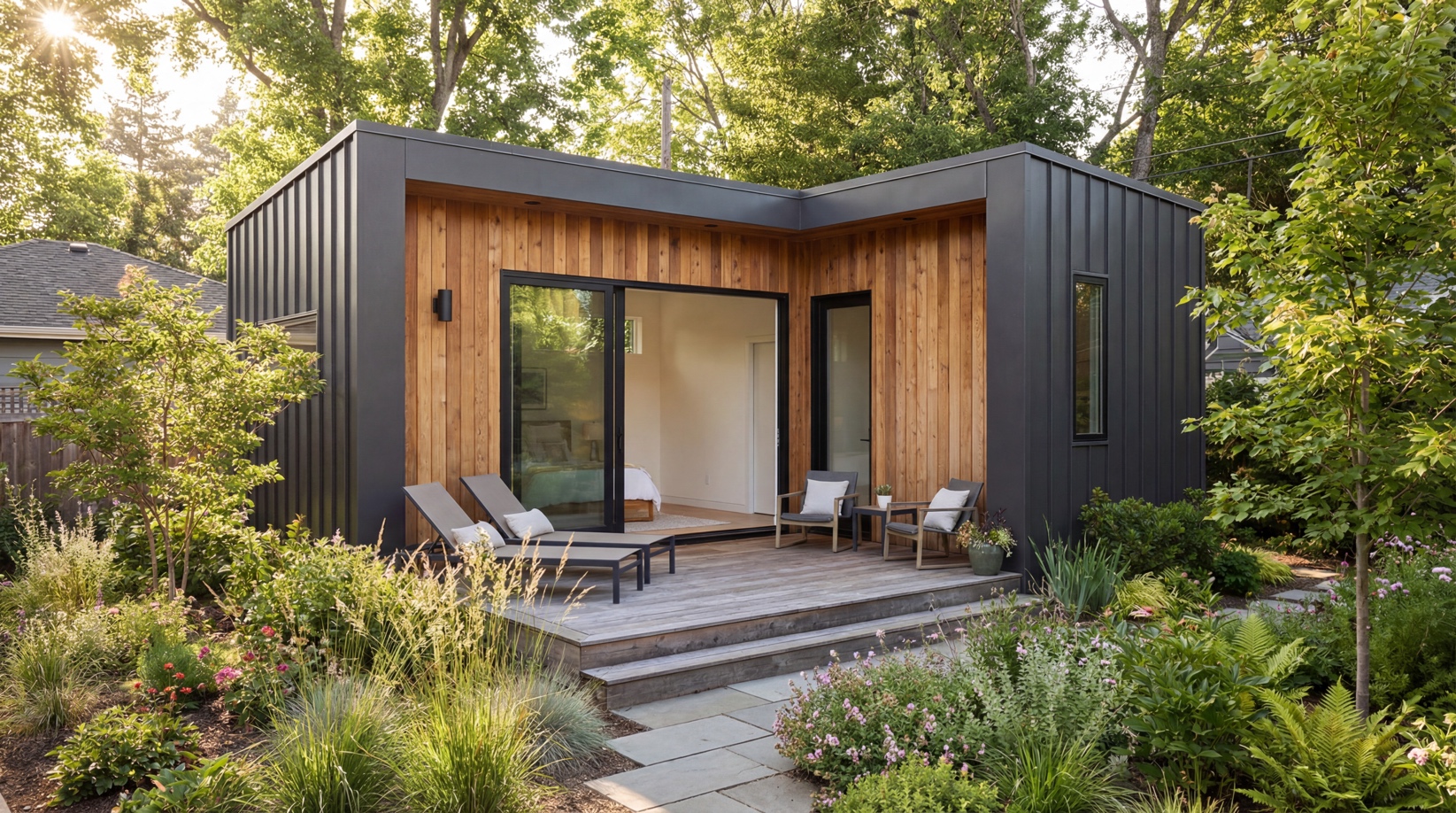
Understanding the regulations before you start planning a granny flat on the Gold Coast is essential. Get it wrong and you face costly redesigns, approval delays, or a build that does not comply. This guide covers everything you need to know about Gold Coast secondary dwelling regulations in 2026 — from size limits and setbacks to approval pathways and rental rules.
On the Gold Coast, most granny flats are assessed as secondary dwellings. The key issues are usually size, setbacks, site cover, overlays, services, parking, rental rules and whether the proposal can stay within the accepted-development pathway or needs a Development Application. Design Science can prepare granny flat design drawings and supporting documentation, but we do not issue approvals, act as council or act as a building certifier.
If you are ready to start designing, see our Gold Coast granny flat design service →
Under the Gold Coast City Plan, a granny flat is officially termed a secondary dwelling. It is a self-contained living space on the same lot as an existing dwelling, smaller than and subordinate to the primary dwelling. It must include its own kitchen, bathroom, and living area to qualify as self-contained.
A secondary dwelling can be:
It must remain on the same lot — it cannot be separately titled or sold independently. If you want to create two separately titlable dwellings, you are looking at a dual occupancy development, which has different planning rules.
Not every Gold Coast property can accommodate a secondary dwelling. The key eligibility requirements are:
Properties with overlays — flooding, bushfire, heritage, environmental protection — may face additional requirements or restrictions. Your building designer should check these before you commit to a design brief. (For the broader picture of how zoning, overlays and setbacks shape your options, see what you can actually build on your block.)
The maximum size for a Gold Coast granny flat is 80 square metres of gross floor area (GFA). Council may approve up to 120 square metres with proper justification, but exceeding 80 square metres triggers infrastructure charges.
The GFA calculation includes all enclosed habitable and non-habitable spaces — bedrooms, living areas, kitchen, bathroom, laundry, and internal circulation. Carports, patios, and unenclosed outdoor areas are generally excluded.
Exceeding 80 square metres of GFA triggers Gold Coast City Council infrastructure charges:
These charges apply from the first square metre over 80. The cost and administrative complexity of exceeding the threshold rarely justifies the extra space for most clients. Designing to 80 square metres or under is the right commercial decision in most cases.
The Gold Coast City Plan limits secondary dwellings to a maximum of two bedrooms. This applies regardless of the floor area — even a 120 square metre granny flat cannot have three or more bedrooms. The design challenge is making those two bedrooms work within a compact overall footprint.
| Size | Bedrooms | Typical Layout |
|---|---|---|
| 40–55 sqm | 1 | Open-plan kitchen/living, 1 bedroom, bathroom, European laundry |
| 55–70 sqm | 1 | Separate kitchen and living, 1 bedroom, bathroom, laundry alcove |
| 70–80 sqm | 1–2 | Living, kitchen, 2 bedrooms, bathroom, laundry |
Secondary dwellings on the Gold Coast must comply with the same setback requirements as the primary dwelling:
On a standard 450–600 square metre block, these setbacks significantly limit where the secondary dwelling can be placed. A site plan drawn to scale — showing the primary dwelling, setback lines, and available build area — is the essential first step in any granny flat design.
The secondary dwelling must comply with the same maximum building height as the primary dwelling — generally 9 metres in low-density residential zones. In practice, most granny flats are single-storey and sit well under this limit. A two-storey secondary dwelling is technically possible under height rules but faces setback and privacy constraints that make it impractical on most standard blocks.
The granny flat’s footprint is added to the primary dwelling’s footprint when calculating site cover. The combined coverage of all buildings on the lot must not exceed the maximum site cover for your zone — typically 50% in low-density residential areas. On a 450 sqm lot, a 50% limit allows 225 sqm of total building footprint across both dwellings.
The secondary dwelling generally must be located within 10 metres of the primary dwelling. This requirement maintains the subordinate relationship between the two structures. On larger or rural lots there may be more flexibility, but on standard suburban lots this rule effectively rules out granny flats placed at the very rear of deep blocks.
Council prefers secondary dwellings to match the primary house in materials and colour palette. If the designs differ substantially, the City Plan requires that only one dwelling should be visible from the street. In practice, matching your granny flat to the main house is the better design decision — it reads as a cohesive property, which matters for both aesthetics and resale value.
Secondary dwellings must share the same driveway entry as the primary house. A separate driveway access for the granny flat is very unlikely to be approved. Your design must accommodate vehicle access, parking, and turning for both dwellings using the existing entry point.
An additional car parking space is required for the secondary dwelling in most zones. This must be on-site and accessible without using the street as a turning area. On smaller lots, meeting the parking requirement while maintaining driveway access and setback compliance is one of the more challenging aspects of the site design.
Windows and outdoor living areas of the secondary dwelling must be designed to minimise overlooking of the primary dwelling and neighbouring properties. This may require offset window placement, screening, or strategic landscaping. A building designer will resolve privacy requirements during the design stage rather than leaving them as conditions of approval.
The granny flat connects to the same water, sewer, and electricity as the main house. If the dwelling will be rented, separate metering is advisable. Service connection costs vary depending on site conditions and distance from existing connection points — budget $5,000–$15,000 as a starting estimate.
All new dwellings must meet NCC 2022 energy efficiency requirements, including a 7-star NatHERS rating. For a well-oriented building, achieving 7 stars is straightforward with good passive design — north-facing living areas, shaded western glazing, appropriate insulation, and sealed construction. If the site orientation is constrained, additional measures such as higher-performance glazing or ceiling fans may be required.
If your granny flat design meets all requirements of the Gold Coast City Plan secondary dwelling code — and your property has no applicable overlays — it qualifies as accepted development. You proceed directly to building approval through a licensed building certifier without a full Development Application to Council. This is faster and cheaper.
A DA to Gold Coast City Council is required if:
Council’s standard DA assessment period is 25 business days, but in practice most decisions take 8–12 weeks. If Council requests further information, the assessment clock stops until you respond — adding further time.
Understanding your approval pathway before spending money on full design documentation is critical. This is one of the first things we confirm in any design consultation.
There is no single minimum lot size for a secondary dwelling across all Gold Coast zones. The key requirement is that the site can accommodate the secondary dwelling while meeting all setback, site cover, parking, and access requirements simultaneously. In practice, lots under 450 square metres rarely have the physical space to comply with all requirements.
Lots with challenging shapes — narrow frontages, irregular boundaries, significant slope — may face additional site design constraints. A building designer can assess whether your specific lot can practically support a secondary dwelling before you invest in full documentation.
Yes. Since the Queensland Government removed occupancy restrictions in September 2022, secondary dwellings can be rented to anyone on the private market — not just family members. There is no requirement for the property owner to live on-site.
Short-term letting (such as Airbnb) may attract additional planning assessment depending on your zone and the frequency of letting. If you are planning to use the granny flat primarily as short-term accommodation, confirm the zoning rules with Council before proceeding.
The Gold Coast rental market for well-designed secondary dwellings is strong. Expect $350–$600 per week depending on location, size, and finish level. At $450 per week, a granny flat generates $23,400 annually — a meaningful return on a $200,000 construction investment, though individual circumstances vary. For the full investment maths — gross yield, the running costs people forget, and what makes a block viable for a rentable flat — see our granny flat rental income guide.
| Cost Component | Typical Range |
|---|---|
| Design and documentation | $5,000 – $10,000 |
| Engineering | $2,000 – $4,000 |
| Building certifier fees | $2,000 – $4,000 |
| Infrastructure charges (over 80 sqm only) | $17,000 – $24,000 |
| Construction (60–80 sqm) | $150,000 – $220,000 |
| Service connections | $5,000 – $15,000 |
| Landscaping and fencing | $5,000 – $15,000 |
| Total (under 80 sqm) | $169,000 – $268,000 |
Construction costs for Gold Coast granny flats typically run $2,000–$2,800 per square metre — comparable to or slightly higher than a standard home on a per-square-metre basis. The cost per sqm is higher because kitchens and bathrooms represent a larger proportion of the total floor area in a small dwelling.
If your primary goal is rental income or adding developable value to your property, it is worth comparing a secondary dwelling against a dual occupancy (duplex) development before committing to either path.
| Feature | Secondary Dwelling | Dual Occupancy |
|---|---|---|
| Maximum size | 80 sqm (120 sqm with charges) | No limit (subject to zone) |
| Separate title | No | Yes (if subdivided) |
| Can be sold separately | No | Yes |
| Infrastructure charges | Nil under 80 sqm | Full charges apply |
| Approval | Often accepted development | Usually requires DA |
| Construction cost | $150,000 – $250,000 | $300,000 – $600,000+ per unit |
A secondary dwelling is faster, cheaper, and simpler. A dual occupancy gives you a separately saleable asset with no size restriction. Which is right for your property depends on your site, your budget, and your long-term plan for the land.
The standard maximum is 80 square metres of gross floor area. Council may approve up to 120 square metres with justification, but exceeding 80 square metres triggers infrastructure charges of approximately $17,000–$24,000 (indexed annually — confirm the current figures with Council). The 80 sqm limit applies regardless of lot size. A maximum of two bedrooms applies in all cases.
Yes — every secondary dwelling on the Gold Coast requires at minimum a Building Approval from a licensed building certifier. Whether you also need a Development Approval from Gold Coast City Council depends on your property’s zoning, overlays, and whether the design complies with all secondary dwelling code requirements. A fully compliant design on a lot with no overlays may proceed as accepted development (building approval only). Any overlay or code non-compliance triggers a Development Application.
Yes. Queensland removed the family-member-only restriction on secondary dwelling occupancy in September 2022. Secondary dwellings can now be rented to anyone on the private rental market. Short-term letting (Airbnb) may attract additional planning requirements depending on your zone — check with Council before listing for short-term accommodation.
Secondary dwellings must maintain a 6-metre setback from the front boundary, 1.5 metres from side boundaries, and 6 metres from the rear boundary (with possible relaxations on some lots). These are the same setbacks as the primary dwelling. On a standard 450 sqm block, these setbacks significantly reduce the available build zone — a site plan drawn to scale is essential before committing to a design brief.
Now that you understand the regulations, the next step is getting a professional design that works within them. At Design Science, we hold both a Builder’s Licence and a Building Designer Licence — which means we design granny flats around the relevant rules, construction reality and the budget the project needs to be buildable within.
Still deciding whether the project makes sense for your block and budget? Read our guide to whether a granny flat is worth building on the Gold Coast.
Learn about our granny flat design service →
Once you know what the rules allow, the next question is what it costs — my granny flat cost guide has the 2026 numbers.
Start with a paid consultation. Request a consultation — the consultation fee is $280, credited against your design contract if you proceed. We’ll assess your block, project goals and likely constraints before you commit to full design work.
David Steadman
Licensed Builder & Building Designer
David Steadman is the founder of Design Science, a Gold Coast building design practice backed by over 30 years of hands-on construction experience. One of few Australians holding both a QBCC Builder's Licence and Building Designer licence, David brings a rare combination of design thinking and practical building knowledge to every project.
Fully insured • Personalised consultation • Transparent pricing
Transparent pricing with no hidden costs. 3D modelling and construction documentation are provided as set out in your agreed design scope. A complete bill of quantities can be prepared for an additional fee.
Request a Consultation

