Want a home that stays comfortable without relying on air conditioning? I design energy-efficient homes that work with the Gold Coast climate — not against it. Request a Consultation to discuss your project, or see how our design process works.
Sustainable home design on the Gold Coast starts with orientation, ventilation, shading and the building fabric — the decisions that shape how a home performs before any equipment is added. Design Science assesses your block, its climate exposure and your budget, then prepares design documentation a builder can price and build from, with the energy-rating pathway identified early rather than retrofitted at the end. We do not issue approvals or act as council or certifier; NatHERS assessment and certification are carried out by the relevant accredited professionals using the documents prepared for your project. Because David holds both a QBCC Builder’s licence and a Licensed Building Designer’s licence, the design is tested against construction reality early, when changes are still cheap.
Sustainable home design is an approach that considers energy efficiency, occupant comfort, and environmental impact from the very first sketch. It means orienting your home to capture winter sun and block summer heat. It means selecting materials that perform well thermally. It means designing windows, ventilation paths, and shading that reduce your reliance on mechanical heating and cooling — without compromising on the way you want to live.
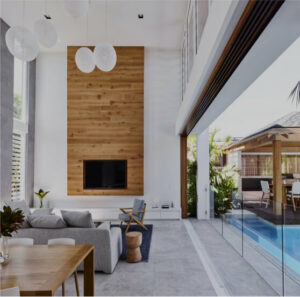
On the Gold Coast, we have a significant advantage: a subtropical climate that lends itself beautifully to passive design. With the right orientation, cross-ventilation strategy, and shading, you can create a home that stays comfortable for most of the year without touching the air conditioner. I have been designing energy-efficient homes on the Gold Coast for over 15 years, and my construction background means every sustainable feature I design is practical, buildable, and cost-effective.
Passive design is about using the building itself — its orientation, form, materials, and openings — to regulate temperature and comfort. On the Gold Coast, the key principles are straightforward but powerful when applied properly.
North-facing living areas capture low winter sun for natural warmth, while eaves and shading devices block the high summer sun. East and west-facing windows are minimised or heavily shaded because they cop the worst of the summer heat. Cross-ventilation is designed into every living space, using the prevailing breezes to flush warm air and keep rooms comfortable naturally.
Thermal mass, insulation, and glazing selection all play a role. A well-insulated home with the right glass specifications and adequate thermal mass will maintain a stable internal temperature regardless of what is happening outside. These are not expensive add-ons — they are design decisions made at the planning stage that cost little or nothing extra when built into the design from the start. Learn more about my approach to design.
The National Construction Code (NCC) 2022 introduced significantly higher energy efficiency requirements for residential buildings. New homes and major renovations now need to achieve a minimum 7-star NatHERS rating (up from the previous 6 stars), along with a whole-of-home energy budget that covers fixed appliances, lighting, and hot water systems.
For Gold Coast homes, meeting these requirements means paying closer attention to glazing performance, insulation levels, and building envelope design. The good news is that if passive design principles are integrated from the start, achieving 7 stars or higher is entirely achievable without adding significant cost. The problems arise when energy performance is treated as an afterthought — trying to retrofit a poorly oriented design to meet NCC requirements is expensive and often compromises the design.
I incorporate energy performance into my designs from day one. By the time we submit for building approval, the NatHERS assessment is not a hurdle — it is a confirmation that the design works as intended. This approach saves you money on both the energy assessment and on the long-term running costs of your home.
This is probably the question I get asked most often, and the honest answer is: it depends on what you mean. Sustainable design does not have to cost more to build. Many of the most effective passive design strategies — orientation, window placement, cross-ventilation, shading — are design decisions that have zero or minimal impact on construction cost. They just require a designer who understands how they work and integrates them from the beginning.
Where costs can increase is with specific products or systems — high-performance glazing, additional insulation, solar panels, or rainwater harvesting systems. But these need to be assessed on a case-by-case basis. A well-oriented home with standard materials will outperform a poorly designed home with expensive add-ons every time.
My approach is to maximise passive performance first, then look at active systems where they make genuine financial sense. I will never recommend a product or system unless I believe it will deliver real value for your specific project and budget. Get in touch to discuss how sustainable design can work for your home.
Whether you are building new or renovating an existing home, sustainable design principles can dramatically improve your comfort and reduce your running costs. And on the Gold Coast, with our climate and lifestyle, there is no reason not to design this way. Explore our custom home design service or see how we approach renovation design.
A NatHERS star rating is a useful benchmark, but it is only part of the story. Real-world performance depends on how the home is actually built and used. I design with construction quality in mind — specifying details that are achievable on site and that maintain the thermal envelope as intended. Insulation that is properly installed, windows that are correctly sealed, and ventilation paths that actually work are the difference between a home that performs as modelled and one that does not. My builder’s licence means I understand these construction details intimately, and I design accordingly. See our full design process.
"David actually respects a budget, thinks practically, and is relentlessly solution-focused. He cares more about delivering for the client than unnecessarily spending a client's money. He listens, truly listens, understands what you mean, and makes the whole journey centred around you as the client."
"David did the design for our house extension and we couldn't be happier. The builders commented that the plans and design were really well done and made a lot of sense to them — they weren't surprised when I told them Dave also has a building background."
Read all reviews · 5.0 out of 5 on Google
Request a consultation to discuss your project. The $280 consultation fee is credited in full if you proceed to design.
Already formulated your vision? Or seeking a start point and guiding hand?
We can help you commence your journey today.
Fully insured • Personalised consultation • Transparent pricing
Transparent pricing with no hidden costs. Every project includes full 3D digital modelling, detailed construction documentation, and a complete bill of quantities.
Request a Consultation